
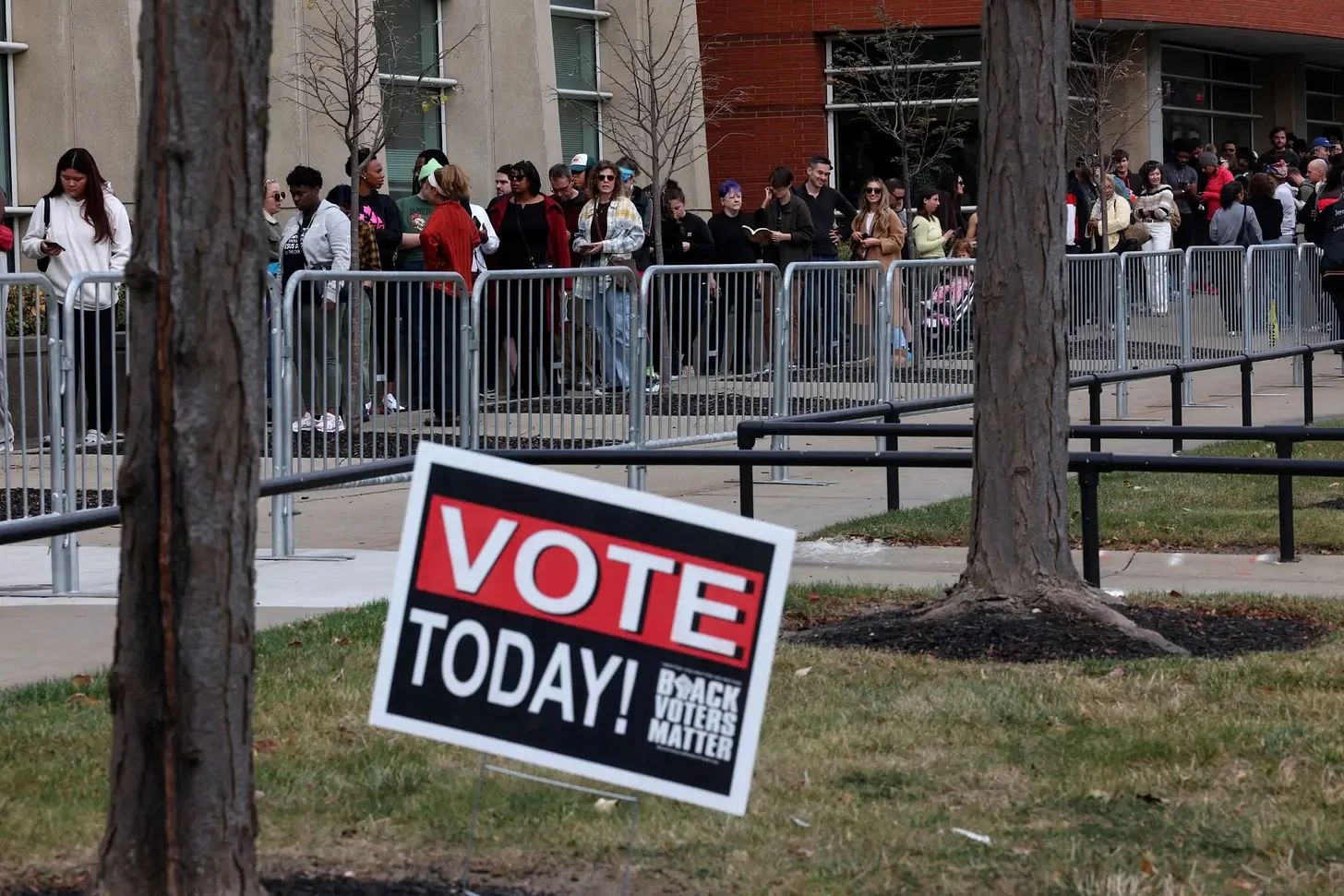
People wait in line outside the Cuyahoga County Board of Elections for early voting ahead of the midterm elections in Cleveland, Ohio, on November 1, 2026. Shannon Stapleton/Reuters.
I filled my Tuesday afternoon calendar with therapy clients because I didn’t want to sit in front of my television listening to prognostications before any ballots were counted. I finally sat down for dinner at 6:15pm and checked the screen. Talarico was leading in the Texas senate race, which I thought he would win. I’d given money to his campaign because he seemed like a decent, thoughtful candidate who was running against Donald Trump’s candidate, Ken Paxton, who nearly matched Trump in moral corruption and grifting.
Then I noticed the scroll across the bottom of the screen that indicated that Gina Hinojosa was leading governor Greg Abbot by as much as Talarico was leading Paxton, and I had my first moment of What’s going on? Now we know. What was just beginning became a tidal wave as report after report tallied the monstrous sweep of Democrats into House and Senate and state and local offices.
By bedtime, it was clear that what had seemed a whisper of hope in the spring and a fanciful possibility in September was now a political reality: MAGA was drowning in a tide of blue victories and Donald Trump’s reign of economic chaos and moral corruption was slamming up against the reality of a majority’s disgust and rejection. It was a gateway to a pleasurable, peaceful night’s sleep.
Over the next few days, I immersed myself in conversations, articles, and the opinions of talking heads, trying to parse more carefully, more thoughtfully what had just happened. I tried to make sense out of what seemed like an entirely new political reality and was surprised by some of my reactions. After Texas chose Democrats to fill every elective state-wide office, Ted Cruz made a video boasting that he was the only Texas Republican left standing and that he could guarantee that under his leadership Texas would soon be a red state again. I shouted back at the screen, Ted, just sit down and shut up. We don’t care what you think about all of this. You’ve lost your credibility and your power. It felt great to shout like this.
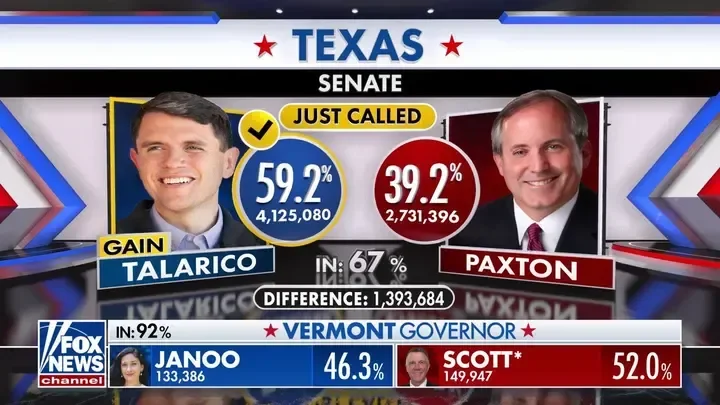
I flipped to Fox News after reading that Lachlan Murdoch, who now runs his father’s businesses, said that the steep decline in Fox News’s audience in the weeks before the election was because of viewer exhaustion. Really, Lachlan? Viewer exhaustion? Where were you Tuesday night when the country was electrified with energy because they’d voted against that tribe you’ve cheered on since Trump came down the escalator over a decade ago?
Laura Ingram and Jesse Waters and Sean Hannity and The Five have exhausted not viewers’ energy but rather their tolerance for the fake news (I wanted to write bullshit) they’ve been spewing to pander to the president who has coopted them and Fox as part of his campaign apparatus. Right now, the only people who care about those opinions and still listen in are those whose allegiance mimics their allegiance to a president who has similarly lost all credibility with the vast majority of our fellow citizens. As of Tuesday, fewer and fewer of us care at all what any of you think.
Early in the past decade I gave up on trying to find common ground with my MAGA adversaries. There is a certainty in their convictions that is not open to honest exchange, reasoned debate, the possibility that not only I but they might occasionally be wrong and actually change their minds. Their convictions seem more fundamental than any devotion to what might be the reasonable truth that contradicts their beliefs. It took too long, but I’ve finally given up hope that reasonable, respectful dialogue with them is a possibility. I don’t care what they think.
The new Congress will be sworn in on January 3rd, and I’ve begun to wonder and to worry about how the new Democratic majority will behave. I hope they are equally uninterested in the thoughts and opinions of those who have shown themselves to be uninterested in democracy and the welfare of the American people.
I hope Democrats will agree that such collaboration across the aisle is a fool’s game. I hope they let their failed Republican opponents whine and shout and insist that they be given a place in a reasonable conversation they have avoided for over a decade. I hope they pay no attention to them unless they reach out and ask to be part of a serious legislative process that feeds children and relieves AIDS suffering in Africa and restores cuts to Medicare and reopens all those clinics and hospitals, the majority of them in red states.
If they sincerely want to join in these efforts, we should welcome their votes. If not, we must not waste energy on some nonsense about collaboration. They have proven that their only collaboration is with their disgraced and degenerate leader and with their own corrupt best interests.

Tony Millionaire/New York Magazine
In several conversations over the past three days (I’m writing Friday morning), friends and some pundits have insisted that the focus of the new Congress should be on kitchen table issues: making food and fuel more affordable, expanding the availability of health care, doing serious work on making housing more accessible to lower- and middle-income families. Amen to all of this.
But since we know how to walk and chew gum at the same time (all credit to Senator Raphael Warnock for this framing), I think it’s imperative that we also pursue justice by holding accountable those who’ve broken so many laws.
I don’t think it’s a waste of time and political capital to impeach the president.
It is instead a way to honor our commitment to the rule of law and ensure that consequences exist for those who flout it. He has disgraced and plundered his office, and in order to restore a sense of integrity and dignity to the presidency as well as to forestall the malignant efforts of future authoritarians, we need to purge ourselves of this horrible man. I wonder how many, if any, of the remaining Republican senators would join this vote to restore their own integrity and dignity. Who cares. I think it’s the right thing to do.
I recently told a friend that I’d given several hundred dollars to a handful of this election’s candidates and subsequently got eight to ten emails and texts every day from each of them, asking for more. The week before the election, I saw a cartoon of two stranded men sitting under a single palm tree on a small island in a vast, empty ocean. One of them has answered his phone and says to his friend, It’s James Talarico calling. I know the feeling.
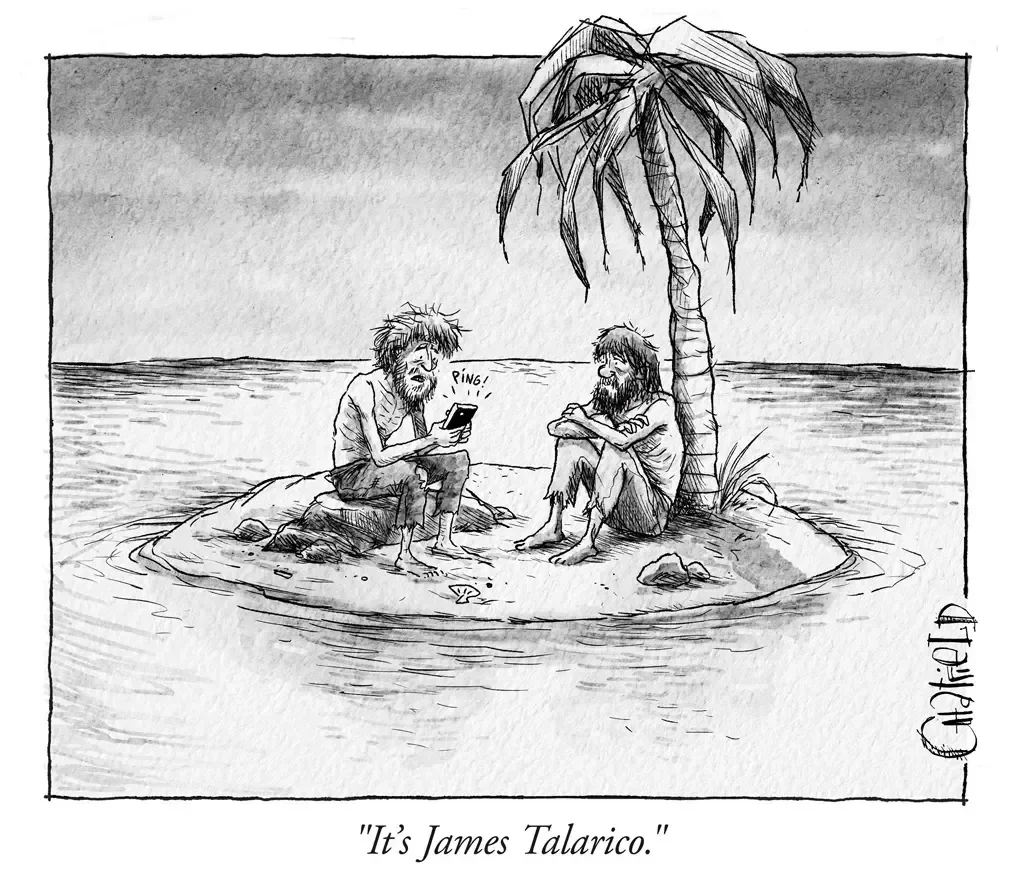
Cartoon by Jason Chatfield for the The Borowitz Report (October 26, 2026)
My friend wisely pointed out that my donations were a pittance of what they raised. The Texas senatorial election cost around four hundred million dollars, the same amount Elon Musk lit on fire to support conservative candidates. My favorites want my gifts to keep coming as food for the money monster that candidates must feed between elections, which is why Talarico and the others will keep texting me.
But one of the startling experiences of watching these election results was that we are stronger than the money. It mattered, of course, as it always does. But not as much as I feared it might. Musk gave Paxton’s campaign nearly two hundred million dollars, and he lost by eight percentage points. Musk and the American Israel Public Affairs Committee collectively gave fifty million dollars to defeat Michigan Senator Elect Abdul El-Sayed, who won his seat by seven percentage points.
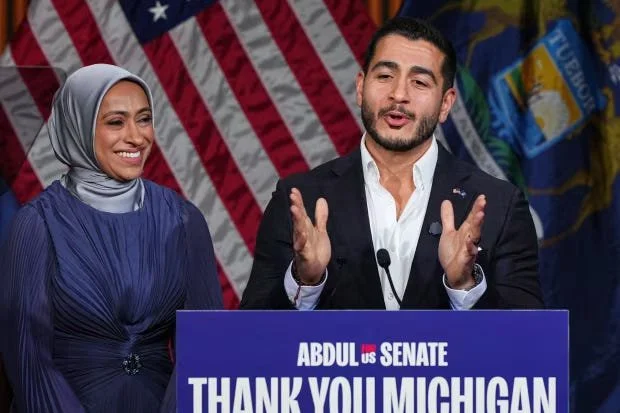
Abdul El-Sayed at an election-night event in Detroit. Julia Demaree Nikhinson/AP
Yes, campaign funds still matter. Yes, every office holder is already using their Rolodex to contact donors. Yes, I’ll keep getting desperate-sounding emails. Yes, candidates and organizations from both sides are dependent primarily upon the same class of wealthy donors for their personal and political survival.
Here’s the question that haunts me, and that only time and voting patterns will answer: will this quest for funds and the incentives of the system as it has been override moral and humanitarian considerations among Democrats and their allies as surely as it has castrated the moral and political courage of Republicans? Every elected politician is faced with this moral dilemma: Dare I lobby and vote for issues that counter the wishes of those who fund my candidacy? Will Democrats find some way to navigate this constant threat?
For me, it’s been an exhilarating election week. Soon I’ll discover whether this exhilaration becomes courageous political action.